Seattle Real Estate Excise Tax: What Sellers Should Know
The Real Estate Excise Tax (also known as REET) is one of those costs that’s part of selling real estate in Washington State. For Seattle home sellers, this excise tax typically adds up to somewhere between 1.5% and 2% of a home’s sale price, depending on where your home falls on the graduated scale.
There are many details involved in selling your home, and we love working alongside our clients every step of the way. You’re not in this alone! We always think it’s a good idea to educate yourself, but know that we’re there to guide you and help figure it all out together. (Take a look at our Seller Guide for some insight into what it’s like to collaborate.)
If you’re getting ready to sell your home, one of the closing costs that catches many Seattle home sellers off guard is the Real Estate Excise Tax, or REET. It can be one of the largest line items on a seller's closing statement, and yet it seems like many people don't hear about it until they're deep into the transaction. We’re here to keep you informed throughout the entire selling process, and this is just one of the many things that we help our sellers account for!
In this post, we’re sharing key details that Seattle home sellers need to know about the Real Estate Excise Tax, including how much it is, who pays it, local considerations, and more. Keep in mind that the details can change and every situation has nuance, so you’ll always want to take a fresh look at the details when you’re ready to sell your home.
What Is the Real Estate Excise Tax?
The real estate excise tax is a Washington State tax on the sale of real property. It's not a recurring annual tax, like property tax. It only applies once, at the time of sale, when ownership of the property transfers from one party to another.
Every sale of real property in Washington is subject to REET unless a specific exemption applies. The tax must be paid before the county will record the deed, which means it has to be settled before the sale is officially complete.
You can find in-depth details about REET on Washington State’s Department of Revenue website.
Who Pays the Real Estate Excise Tax?
By default, the seller is responsible for paying REET. Your escrow or title company will typically handle the calculation and submit payment to the King County Treasurer as part of closing.
That said, if the seller doesn't pay, the buyer is on the hook. The tax can even become a lien against the property itself. In practice, this rarely happens because escrow companies handle it automatically, but it's worth understanding who bears the legal responsibility.
How Much Is Washington State’s Real Estate Excise Tax (REET)?
Washington uses a graduated rate structure for the state portion of REET. This means the tax rate increases as the sale price goes up, similar to how income tax brackets work. You don't pay the highest rate on the entire sale price—only on the portion that falls within each bracket.
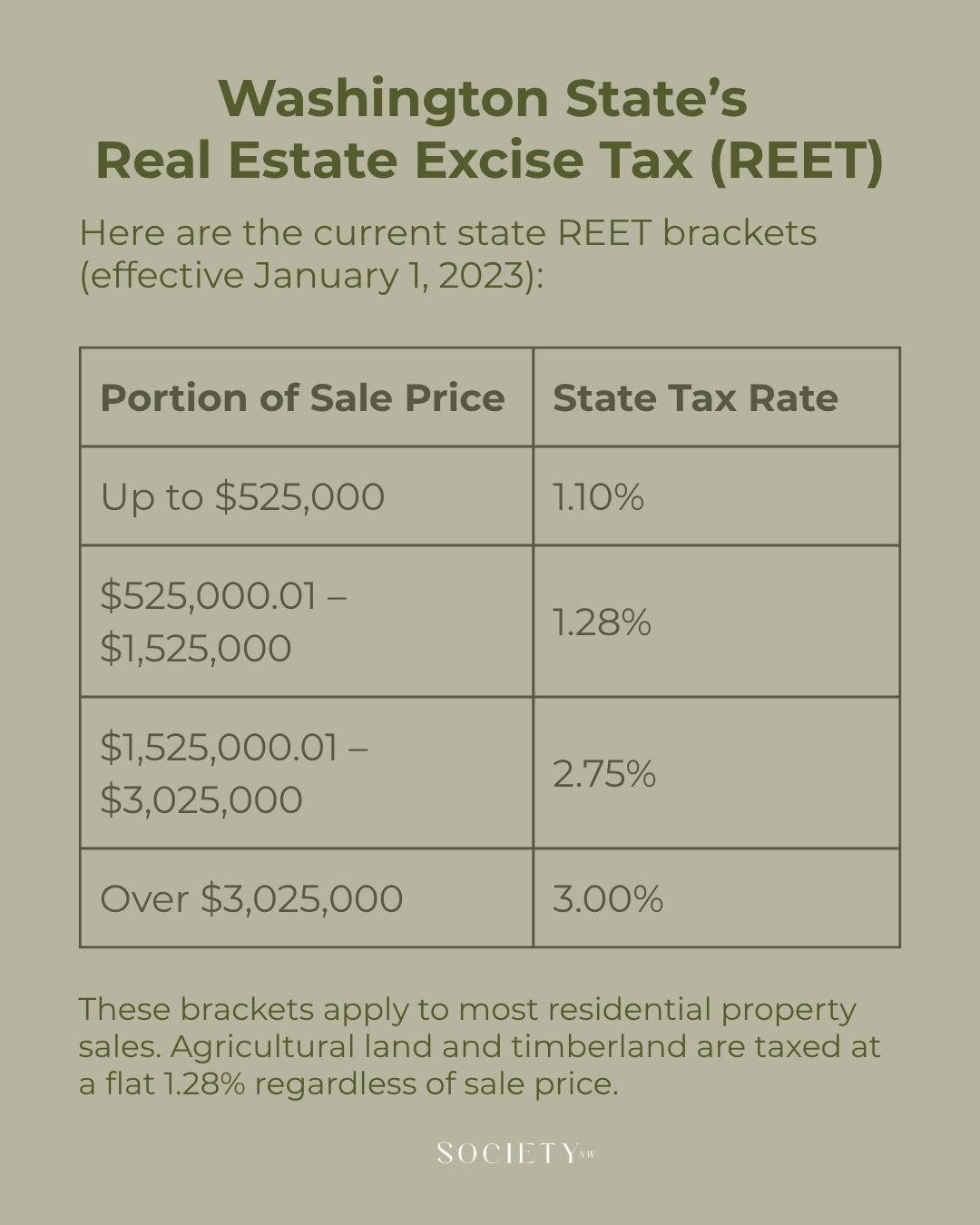
These brackets apply to most residential property sales. Agricultural land and timberland are taxed at a flat 1.28% regardless of sale price.
Do Seattle & King County Have A Local REET?
Yes. On top of the state tax, cities and counties in Washington add their own local REET. In Seattle and most King County cities, the local rate is 0.50% of the full sale price. Unlike the graduated state portion, the local rate is a flat percentage applied to the entire sale price. Information on the local REET is more challenging to find online; you can reference “Local Real Estate Excise Tax Rates - Rates Effective April 1, 2025” to see rates for cities and counties throughout Washington.
Putting It All Together: A Seattle Example
Let's say you're selling a home in Seattle for $2,000,000. Here's how the total excise tax breaks down:
State portion (graduated):
-
$525,000 at 1.10% = $5,775
-
$1,000,000 ($525,001 – $1,525,000) at 1.28% = $12,800
-
$475,000 ($1,525,001 – $2,000,000) at 2.75% = $13,062.50
-
$0 at 3%= $0
-
State total: $31,637.50
Local portion (flat 0.50% on full price):
-
$2,000,000 × 0.50% = $10,000
-
Local total: $10,000
Total REET due at closing: $41,637.50
At this price point, REET works out to about 2.08% of the sale price — over $41,000 out of your proceeds. And the higher your sale price climbs, the more the graduated brackets bite. Running the numbers in advance helps avoid sticker shock at the closing table.
When Is REET Due?
The tax is due on the date of a home sale. Your escrow company will collect payment and submit it along with a Real Estate Excise Tax Affidavit to the King County Recorder's Office.
If the tax isn't paid within one month of the sale date, late penalties will kick in, and interest also accrues monthly on any unpaid balance.
Are There Any Exemptions to the Real Estate Excise Tax (REET)?
There are exemptions, but they're narrow and strictly enforced. The most common ones that Seattle homeowners might encounter include:
-
Gifts where no money or value changes hands (requires a supplemental statement)
-
Transfers through inheritance or probate
-
Divorce settlements that transfer property between former spouses
-
Title corrections that don't change who actually owns the property
-
Government transfers to or from a public entity
What Is The Difference Between REET vs. Property Tax vs. Capital Gains Tax?
These three taxes often get confused, so here's the quick distinction:
-
Property tax is an annual tax based on your home's assessed value. You pay it every year you own the property.
-
Capital gains tax applies to the profit you make when selling certain assets. Washington State has its own capital gains tax on gains over $270,000 from the sale of certain assets, though the primary residence exclusion shelters most homeowners.
-
REET is a transaction tax. It applies to the act of selling the property, regardless of whether you made a profit or took a loss. Even if you sell your home for less than you paid, you still owe REET on the sale price.
What Should Seattle Home Sellers Do to Prepare?
Understanding REET before you list your home allows you to price smarter and set realistic expectations for your net proceeds.
Here are a few practical steps you can take:
-
Run the numbers early. We are ready to guide you in running allllll of the numbers involved in selling your home! Ask us and your escrow officer to estimate your REET obligation based on your expected sale price.
-
Confirm your local rate. While most Seattle and King County cities charge 0.50%, local rates do vary by jurisdiction. If you're selling in an unincorporated area or a smaller city, the rate could be different. We’ll make sure that you have the most up-to-date information.
-
Keep your records. The Department of Revenue can audit any REET transaction within four years of the sale date. Maintain documentation of the sale price and any exemption you claim.
It’s Never Too Early To Prepare When Selling Your Home
We love helping our clients strategize, and the more time we have to prepare, the better!
The Real Estate Excise Tax is one of those closing costs that you’ll want to factor into the financial aspect of selling your home. If you have questions, we're happy to walk you through the numbers for your specific situation! You can get in touch with us here.